
The goldfish sold for a few dollars in a pet shop is a baby carp, usually 1–2 inches long, with years of growing still ahead. That is why so many goldfish end up in tanks they cannot fit. This guide gives realistic adult sizes for every goldfish type, a growth-by-age guide, the real reason tank goldfish often stay small, and a tank-planning table so you can set up for the fish your goldfish will become.
In this guide
Adult size by goldfish type
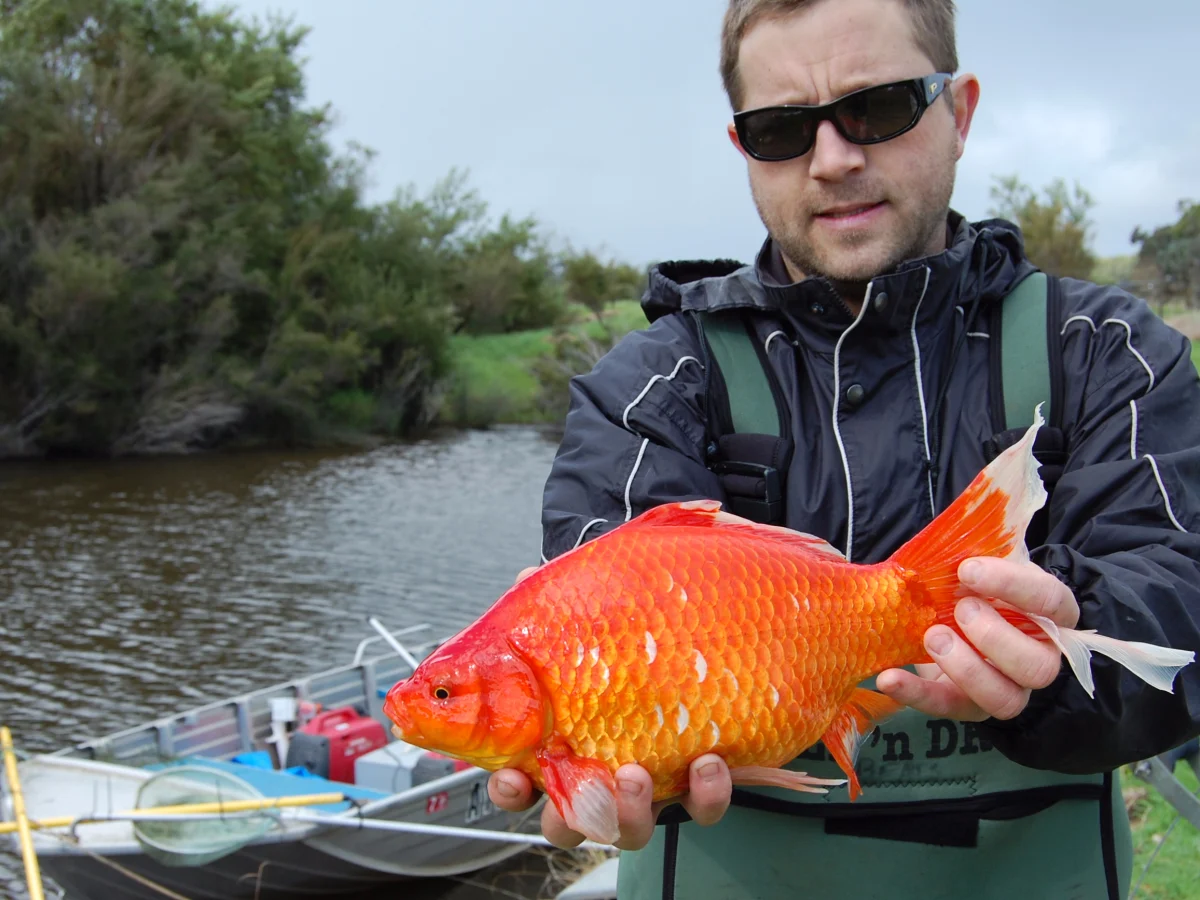
All goldfish are the same species, Carassius auratus, but centuries of selective breeding have produced two very different body plans. Body shape is the single best predictor of how big your goldfish will get.

| Goldfish type | Body shape | Typical adult size in a good tank | Possible in a large pond |
|---|---|---|---|
| Common goldfish | Slim, single tail | 10–12 in (25–30 cm) | 12–18 in (30–46 cm) |
| Comet | Slim, long single tail | 10–12 in (25–30 cm) | 12–14 in (30–36 cm) |
| Shubunkin | Slim, single tail, calico | 9–12 in (23–30 cm) | 12+ in (30+ cm) |
| Fantail, ryukin | Egg-shaped, double tail | 6–8 in (15–20 cm) | Up to about 10 in (25 cm) |
| Oranda, lionhead, ranchu | Round, double tail, head growth | 6–8 in (15–20 cm) | Pond not recommended |
| Black moor, telescope eye | Round, protruding eyes | 6–8 in (15–20 cm) | Pond not recommended |
| Bubble eye, celestial, pearlscale | Very round or delicate | Lower end of the fancy range | Indoor only |
These figures include the tail and are typical, not limits. Individual fish vary with genetics, and sources disagree by an inch or two because some measure with the tail and some without. For breed-by-breed profiles, see our guide to fancy goldfish types.
Fancy vs single-tail goldfish
Confusing these two groups is the root of most “my goldfish outgrew its tank” problems.

Single-tail (slim-bodied) goldfish
Commons, comets and shubunkins have a long, torpedo-shaped body built for fast swimming, close to the wild carp they came from. They are the fish given away at fairs and sold as “feeders”, which is why many owners are shocked when a 2-inch fish becomes a foot-long one. They grow fastest, get biggest, live longest and are really pond fish. Wikipedia’s common goldfish entry notes they can grow beyond 12 inches (30 cm).

Fancy (round-bodied) goldfish
Fancies have short, deep bodies, double tails and features such as head growth or bulging eyes. Their compressed shape limits length, so most finish at 6–8 inches. Many are still heavy, chunky fish at that length, so they need more room than “6 inches” sounds like. A healthy fantail goldfish, for example, is a hand-sized fish when grown.
How fast do goldfish grow?
Goldfish grow fastest in their first year and then slow down, but they keep growing slowly for most of their lives. A widely repeated rule is about 1 inch (2.5 cm) per year, but that hides a lot: young fish in warm, clean, roomy water grow far faster, and adults much slower. There is no exact month-by-month formula for every goldfish.
The figures below are typical lengths for goldfish kept in good conditions, as published in growth guides for keepers. Treat them as a rough yardstick, not a target.
| Age | Typical length | Typical weight |
|---|---|---|
| Newly hatched | About 0.2 in (5 mm) | Tiny |
| 1 month | About 1 in (2.5 cm) | About 0.1 oz (3 g) |
| 6 months | 1.5–2 in (4–5 cm) | About 0.4 oz (11 g) |
| 12 months | 2.5–3 in (6–7 cm) | About 1 oz (28 g) |
| 18 months | 3–3.5 in (8–9 cm) | About 3 oz (85 g) |
| 2–3 years | Approaching adult size for fancies | Varies widely |
| 3+ years | Slow continued growth, especially single-tails | Average adults around 8 oz (225 g); giants several pounds |
Pond goldfish grow in spurts: quickly in spring and summer when the water is warm and food is plentiful, and very little in winter. Tank goldfish kept at a stable temperature grow more evenly through the year.
Size in a tank, a pond and the wild
Where a goldfish lives makes a bigger difference than almost anything else.

In a tank
In a properly sized, filtered tank with regular water changes, fancies typically reach 6–8 inches (15–20 cm) and single-tails 10–12 inches (25–30 cm). In a small, crowded or rarely cleaned tank, many goldfish stall at 2–4 inches. That is stunting, covered below.
In a pond
Pond goldfish commonly reach 12–14 inches (30–36 cm). More water, natural food, sunlight and seasonal warmth all help. Single-tail breeds are the ones that thrive outdoors; most fancies cope poorly with cold winters and fast pond mates.
In the wild
Goldfish released into lakes can become enormous. In 2021 the City of Burnsville, Minnesota, caught dozens of dumped goldfish during a survey of Keller Lake; the biggest were reported at up to 18 inches (46 cm) and about 4 pounds (1.8 kg), with city staff describing some as football-sized. Researchers working on Lake Tahoe in 2013 netted a goldfish of nearly 1.5 feet that weighed around 4.2 pounds. The US Fish and Wildlife Service has used the same football-size, 4-pound comparison when warning the public not to release pet fish.
The biggest goldfish ever recorded
Guinness World Records lists the longest goldfish as one measured in the Netherlands in 2003 at 18.7 inches (47.4 cm) from snout to tail tip. Catches of giant “goldfish” weighing 9–20 pounds occasionally make the news, but these are often koi, koi-goldfish hybrids or unverified weights, so treat them with caution.
For longevity, Guinness recognised a fairground goldfish named Tish, kept in the UK, which lived to 43 years. A long life usually goes hand in hand with good size, because both depend on clean water and space.
Do goldfish grow to the size of their tank?
Partly, but not in the harmless way the saying suggests. A goldfish does not politely “fit” its home. When it is kept in a small volume of water, its growth is suppressed by stress and poor water, and the fish is stunted.
Researchers and fish vets point to several mechanisms:
- Growth-inhibiting substances. Goldfish are linked to the release of compounds such as somatostatin and gamma-aminobutyric acid (GABA), which can suppress growth. In open water these may help larger fish limit competition; in a small, rarely changed tank they build up.
- Chronic waste. Ammonia, nitrite and high nitrate stress the fish, suppress the immune system and divert energy away from growth.
- Low oxygen. A veterinarian-reviewed guide from PangoVet notes goldfish need roughly 5–6 ppm of dissolved oxygen to grow to their genetic potential.
- Poor diet and crowding. Bigger tank mates win the food and dominate smaller ones.
Stunted goldfish are often described as having bodies that stop growing while internal organs keep developing; vets also report that environmentally stunted fish may not breed properly. How much harm stunting does is still debated among keepers, and some argue small, stunted fish can live long lives. The safe conclusion is simple: a fish kept small by its environment is a fish under long-term stress. Many stunted goldfish do resume some growth when moved to a larger, cleaner home, especially young ones, but not all reach full size.
What controls how big a goldfish gets

- Genetics and breed. Sets the ceiling. A ranchu will never reach common goldfish length.
- Water volume. More water dilutes waste and growth-suppressing compounds and gives room to swim.
- Water quality. Ammonia and nitrite should read 0 ppm. Keep nitrate low with regular partial water changes.
- Temperature. Goldfish are cool-water fish, but growth slows in cold water. Vet sources give about 68–72°F (20–22°C) as the range where growth, immunity and breeding are best.
- Oxygen. Good surface movement and a long, wide tank help. Warm water holds less oxygen.
- Diet. A quality goldfish pellet or gel food, plus vegetables and occasional frozen foods. Nutrient quality matters more than quantity.
- Early life. Fish that were stunted or starved as babies in shop tanks may never reach their full potential.
- Health. Parasites and chronic disease slow growth. Quarantine new fish and act early on symptoms.
Checklist: is your goldfish growing normally?
- It has grown noticeably in the last 6–12 months (if under 2 years old).
- Your tank meets the minimum size in the table below for its adult size, not its current size.
- Ammonia and nitrite test at 0 ppm with a liquid test kit.
- You change 25–50% of the water weekly or as tests require.
- The fish eats eagerly and its body looks in proportion: not pinched behind the head, not bloated.
- No larger tank mate is chasing it off food.
If you tick fewer than four, fix the setup before worrying about food. Growth problems and early deaths have the same root causes; our guide to why goldfish die and how to keep them alive goes through them.
Tank planning by adult size
Plan for the fish your goldfish will be in two years, not the one in the bag. A widely used guideline is about 20 gallons (76 L) for the first fancy goldfish plus 10 gallons (38 L) for each extra one. Single-tail goldfish need far more: 40 gallons (151 L) or more for one, and realistically a pond as they mature.
| Setup | Fancy goldfish | Common, comet, shubunkin |
|---|---|---|
| Bowl or under 10 gal (38 L) | Not suitable | Not suitable |
| 10–19 gal (38–72 L) | Temporary for one baby only | Not suitable |
| 20–29 gal (76–110 L) | 1 adult | Temporary for one juvenile |
| 30–39 gal (114–148 L) | 2 adults | Temporary for one juvenile |
| 40–55 gal (151–208 L) | 3 adults | 1 adult |
| 75 gal (284 L) or more | 4–5 adults | 2 adults; plan for a pond |
| Pond, several hundred gallons or more | Hardy fancies only, mild climates | Ideal long-term home |
- Shape: long and wide beats tall. Surface area improves oxygen exchange.
- Filter: rate it for more than your tank volume; goldfish produce a lot of waste.
- Cycle first: let beneficial bacteria establish before adding fish.
- Upgrade early: if your goldfish is visibly crowding its tank, move it before it stalls.
The whole care routine, from filters to feeding, is in our goldfish care guide.
Bigger goldfish also produce far more waste; see do fish pee for where all that ammonia comes from.
Once you know the adult size, use our goldfish tank size chart to pick the right aquarium.
How to measure your goldfish
Measuring helps you track growth and spot stunting early. Do it without stressing the fish:
- Tape a ruler to the outside of the front glass, level with the fish.
- Wait until the fish swims parallel to the glass, close to the ruler.
- Read the length from the tip of the snout to the end of the tail. That is total length, which most care guides quote.
- If you want standard length (snout to the base of the tail), note it separately; on long-tailed fancies it can be several centimetres shorter.
- Take a photo with the ruler visible and repeat every few months.
Never take a goldfish out of the water to measure it; handling removes its protective slime coat.
Frequently asked questions
How big do goldfish get in a tank?
In a large, well-filtered tank, fancy goldfish usually reach 6–8 inches (15–20 cm) and single-tail goldfish 10–12 inches (25–30 cm). In small or poorly maintained tanks they often stall at 2–4 inches because they are stunted.
How big do goldfish get in a pond?
Pond goldfish commonly reach 12–14 inches (30–36 cm), and some single-tail fish grow even larger in big ponds with natural food.
How big do fancy goldfish get?
Most fancy goldfish, including fantails, orandas, ryukins and black moors, finish at about 6–8 inches including the tail. Very delicate breeds such as bubble eyes often stay smaller.
How long does it take a goldfish to reach full size?
Most of the growth happens in the first one to three years. Fancies are usually close to adult size by about 2–3 years; single-tail fish keep adding length more slowly for years after that.
Do goldfish ever stop growing?
Growth slows a lot in adulthood, but goldfish, like most fish, are thought to keep growing very slowly throughout life if conditions allow.
How big do goldfish get in a 10-gallon tank?
A 10-gallon (38 L) tank can house one baby goldfish for a short time, but it is too small for any adult. A goldfish kept there long term is likely to be stunted at a few inches and stressed by poor water.
Can a stunted goldfish grow again?
Often, partly. Moving it to a larger tank or pond with clean water and good food usually restarts growth, especially in younger fish, but a fish stunted for years may never reach full size.
How much do goldfish weigh?
Weight varies with breed and shape. A typical well-kept adult weighs a few ounces to around 8 ounces (225 g); giant feral goldfish have been recorded at about 4 pounds (1.8 kg).